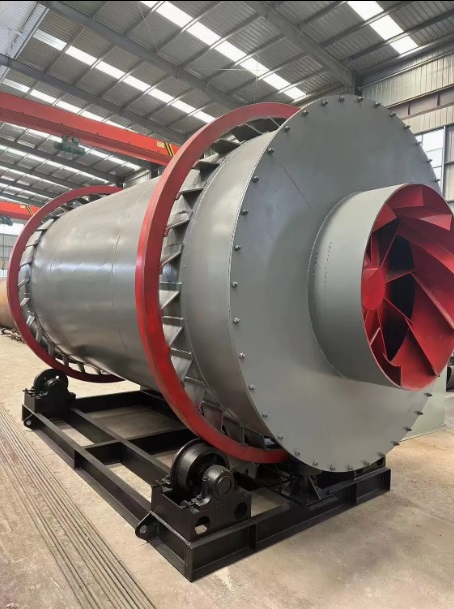
Rotary Kiln Dryer
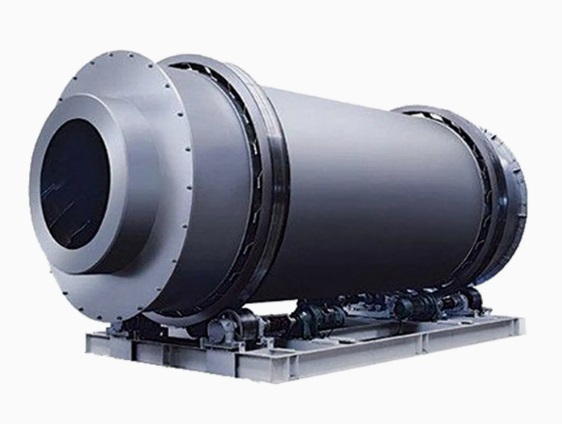
A Rotary Kiln Dryer is a rotating cylindrical vessel dryer, used to reduce the moisture content of materials by exposing them directly to a heated gas. It's characterized by its rotating drum, which is slightly inclined, and the material moves through it due to gravity and rotation. Rotary kiln dryers are widely used in various industries for drying a wide range of materials, including granular materials, viscous pastes, and materials with high moisture content.
Rotary dryers are custom built for each application. They are classified as direct or indirect (air heating method), co-current or counter current (material air contact).
The material to be dried is uniformly dispersed over the entire cross-section, by use of internals designed based on the material properties. Heated air then passes through the falling material, resulting in uniform drying. The dryer is driven through a girth gear and tyre arrangement. Seals are provided at the ends to ensure minimum air leakage.
Key Features and Working principle
- Feeding: Wet material enters the dryer from the higher end of the slightly inclined cylinder.
- Rotation & Tumbling: The cylinder slowly rotates, causing material to tumble due to gravity and internal lifters.
- Heating and drying: Hot gas (either directly or indirectly heated) flows through the dryer, contacting the tumbling material.
- o Direct heating: Hot gas directly contacts the material, transferring heat through convection.
o Indirect heating: Heat is transferred through the cylinder's heated walls (e.g., using steam or hot oil), preventing direct contact between the material and the heat source. - Moisture Removal: Controlled heat (convection or conduction) causes moisture to evaporate uniformly.
- Material Advancement: Cylinder inclination and internal flights gradually move material to the discharge end.
- Discharge & Exhaust: Dried material is collected at the lower end, while exhaust gas is treated via dust collection systems.
Industry Applications
Mineral & Chemical
Drying sands, limestone, ore, coal, fertilizers, and various industrial chemical compounds.
Chemical processing
Drying fertilizers, chemicals, and other industrial materials.
Food processing
Drying grains, cereals, pulses, and coffee beans.
Agriculture
Drying crops, forage, and other plant-based materials.
Waste Management
Efficient drying of sludge, paper, plastics, and metals for recycling or disposal.